Films that Celebrate The Power of Bicycles
Here are recommendations for two films that celebrate the power of bicycles — that students love! The Boy Who Harnessed The Wind and Wadjda.
The Boy Who Harnessed The Wind
In The Boy Who Harnessed The Wind, 13-year-old son William is forced to leave school after when his family falls behind on payments in drought-stricken Malawi. He becomes determined to help not only his family but a community facing famine — and builds a windmill out of scrap materials and bicycle parts. Students love this story of determination, STEM ingenuity, and of course the almighty bicycle. We offer a free curriculum guide with six classroom-ready lessons across 9 subjects in the both the sciences and humanities and also a discussion guide for The Boy Who Harnessed The Wind.
Common Sense Media rates this film as appropriate for ages 12+ and we recommend our reasources for grades 6 and up.
Learn more about teaching with The Boy Who Harnessed The Wind.
Wadjda
Wadjda tells the delightful story of a convention-defying Saudi girl whose heart is set on the impossible goal of getting a bicycle, from Saudi Arabia’s first woman director Haifaa Al Mansour. Our free Wadjda Curriculum Guide features six lessons that put Wadjda’s life as a young girl in modern Saudi Arabia into context, exploring Saudi geography and culture, as well as gender equity, and introduces the groundbreaking work of filmmaker Haifaa Al Mansour.
Common Sense Media rates this film as appropriate for ages 9+. We recommend our Wadjda lesson plans for grades 6 and up.
Learn more about teaching with Wadjda.
Important Dates
May is a great time to celebrate bicycles in the classroom! May is National Bike Month, plus May 5 is National Ride a Bike Day and May 8 is National Walk Bike and Roll to School Day! These films that celebrate the power of bicycles are also a hit with students all year round.
Looking for more global education films? We also recommend Children of Heaven (Iran), Like Stars on Earth (India), Please Vote for Me (China), The Cup (Tibet), The Way Home (South Korea), and Whale Rider (Aotearoa / New Zealand).
12 Films That Celebrate Young Heroes
We’re pleased to offer free teaching resources for award-winning documentaries and feature films with young protagonists who students can relate to. Youth-centered films are a wonderful way to boost student engagement across the curriculum and at the same time increase students’ understanding of themselves and the world around them.
Show Students Heroes That They Can Relate To — With Film
This feature film from Iran tells the story of a young brother and sister on a quest for a new pair of shoes. Our Children of Heaven Curriculum Guide features arts and science lessons, plus an introduction Iran and its culture. It’s a great global education tool.
This Oscar-nominated documentary shares with insight, humor, and joy the experiences of a group of disabled teenagers and their journey to adulthood and activism that sparked a revolutionary disability rights movement. We offer a Crip Camp Curriculum Guide with film studies, media literacy, and humanities lessons, that includes a powerful lesson on language, power and ableism, a great addition to anti-bias education toolkits. We also offer a Crip Camp Discussion Guide that empowers students around activism and civic engagement.
This BAFTA-winning documentary explores the events leading up to the Taliban’s attack on Pakistani schoolgirl Malala Yousafzai for speaking out on girls’ education, followed by the aftermath, including her speech to the United Nations. We offer a He Named Me Malala Curriculum Guide with film studies and humanities lessons, including an English Language Arts lesson about her speech as the youngest ever Nobel Prize Laureate. We also offer a He Named Me Malala Discussion Guide that explores Pakistan, religious extremism, the importance of education, and community engagement.
This award-winning documentary follows the Recycled Orchestra of Cateura, a Paraguayan musical group of students who play instruments made entirely out of garbage. Our Landfill Harmonic Curriculum Guide features lessons about these musical upcycling heroes for arts and science classes.
This a heartwarming feature film from India tells the story of a boy with dyslexia who thrives with the support of his new art teacher. Our Like Stars on Earth Curriculum Guide features lessons across the curriculum, including a science lesson about how the brain works, as well as introductions to India and to Bollywood films.
Please Vote for Me, about elections for class monitor in a Chinese elementary school, is a perfect movie for classroom learning on democracy and voting, especially for Grades 3-7. Our Please Vote For Me Curriculum Guide features lessons across the curriculum, including an introduction to China and several aspects of Chinese culture, as well as a civics lesson about democracy.
Hit Disney film Queen of Katwe follows the rise of young chess prodigy Phiona Mutesi from a slum in Uganda to become an international chess star. Our Queen of Katwe Discussion Guide explores themes of Black Excellence, Black History, Chess, Gender Equity, Mentoring.
In Chewitel Ejiofor’s directorial debut, William Kamkwamba is forced to leave school after when his family falls behind on payments in drought-stricken Malawi. He becomes determined to help not only his family but a community facing famine — and builds a windmill out of scrap materials and bicycle parts. Our The Boy Who Harnessed the Wind Curriculum Guide features lessons across the curriculum, including science lessons that get students excited about engineering and STEM fields. Our The Boy Who Harnessed The Wind Discussion Guide explores themes of Black Excellence, Black History, Character, Climate Change, Desertification, Engineering and Activism, and Wind Power.
This joyful feature film follow the adventures of two young refugee Tibetan monks who are determined to watch the World Cup. Our The Cup Curriculum Guide introduces students to Tibet, Tibetan Buddhism, and the world of refugees, with lessons across the curriculum.
This heart-warming feature film follows a young Saudi girl despite cultural norms about girls’ roles in society desperately wants the freedom of a bicycle. Our Wadjda Curriculum Guide introduces Saudi Arabia, social constructions of gender, and also Saudi Arabia’s historic first woman film director Haifaa Al Mansour (the director of Wadjda).
This acclaimed feature film from Aotearoa / New Zealand follows a young Māori girl who is determined to fulfill her destiny despite traditional gender barriers. (Wadjda and Whale Rider make a great global education double bill!) Our Whale Rider Curriculum Guide introduces Māori culture and features lessons across the curriculum.
This powerful documentary follows the 21 youth plaintiffs suing the US federal government in a landmark climate justice case for their right to a safe climate. Our Youth v Gov Curriculum Guide features lessons that dig into the connections between climate laws, fossil fuels, the government, and the court system. We also offer a Youth v Gov Discussion Guide that caps off the exploration of the films main themes with an inspiring section on community action and engagement.
We hope these materials can help you give your students the unparalleled experience of seeing young people like themselves and their friends on screen as heroes and role models.
Watch and Write: New Classroom Warm-Ups
We’re launching a new classroom warm-up series: Watch and Write! Give your classroom a creative kickstart with a super-short film plus a prompt for writing or discussion. This is a great way to get students engaged and focused.
These exercises are for elementary school, middle school, and high school. They feature animated and live-action films as short as just one minute! The prompts can work for quiet journaling and reflection or for lively classroom discussions — whatever suits your needs.
This new tool is only available in our newsletter as a way of saying thank you to our subscribers. Check out the first installments:
Not a subscriber yet? We’d love to deliver a new Watch and Write to your inbox every month. Sign up now!
Have you been using our Watch and Write exercises in your learning environment? Leave a comment below or send us an email to let us know how they’re working for you!
Related Resource
Watch and Write warm-ups combine well with our free Windows and Mirrors media analysis handout!
Make Teaching Easy with Classroom-Ready Lesson Plans
Simplify your school year with classroom-ready lesson plans from Journeys in Film! Our free curriculum guides for award-winning films contain ready-to-teach lessons for elementary, middle school, and high school instruction.
Our lesson plans are created by teams of area experts and instructional designers to boost student engagement and teach critical thinking across the curriculum. The lesson plans feature handouts, classroom activities, and experiential lessons. The lessons align with Common Core standards and the United Nations Sustainable Development Goals.
Featured Lesson Plans
Anti-Bias Education
Teach about contemporary antisemitism to grades 9-12 plus higher ed. Lesson Eight of our Schindler’s List Curriculum Guide explores contemporary Anti-semitism and its connections with white supremacy. This lesson is also available as a standalone download from our Schindler’s List page. This is a powerful resource for teaching anti-bias education, social emotional learning and media literacy which we highly recommend to Social Studies teachers.
Civics
Teach about the principles of elections and democracy to grades 6-8. Lesson Two of our Please Vote for Me Curriculum Guide explores the values that are essential for a functioning democracy and what happens when elections are not well run. This non-partisan teaching tool is a great educational resource for election years that can be adapted to use with students of different ages.
Mathematics
Yes, you can teach math with film! Teach how to calculate percentages for grades 6-8. Lesson Four of our Like Stars on Earth Curriculum Guide explores fractions, decimals, and percents to demystify how teachers calculate the student averages for grading their classes.
Science
Teach science to grades 5-7. Lesson Eight of our Whale Rider Curriculum Guide is all about the science of how whales communicate with echolocation. The lesson includes a fun science activity that will get students on their feet and engaging with these science principles.
Visual Arts
Teach visual arts to high school students. Lesson Three of our Rebel Hearts Curriculum Guide features a hands-on visual arts lesson for grades 9-12, inspired by the dynamic pop art of Corita Kent.
(more…)
Make the Most of Screen Time
Children’s screen time and media consumption are in the news — and we are here to help. A new study reports that screen time is prevalent under grandparents’ care. The study from the University of Arizona looked at study looked at children’s screen time under their grandparents’ watch. It found that nearly 50% of the time American children spend with their grandparents involves interacting with or watching media on a screen.
The study found that media consumption is not only important for grandchildren, but that understanding media is just as important for grandparents. “Through our research, we discovered that media consumption is not only important for grandchildren, but that understanding media is just as important for grandparents. Grandparents may want to watch along with their grandchildren or just want to understand what the children are watching,” said lead study author Cecilia Sada Garibay.
Good news: we have free tools to make screen time a learning experience for kids and families.
If you are a grandparent or anyone else caring for children, we offer media-based learning materials and activities for kids as young as 8 years old to enrich their media experience. Like all of our resources, these fun, engaging learning tools are free for everyone. Many of those films, series and games are also available for free, as well.
Short Films For Kids
We’ve just launched a new series of free creative prompts based on super-short films that are bite-sized for kids’ attention spans: Watch and Write. Watch a film that’s as short as one minute, then springboard off a prompt for reflection, journaling, discussion or creative writing. The super short films cover a range of subjects and themes, suitable for kids of all ages, from elementary school through high school. The films and prompts are all free. These can be great resources for family viewing and discussion — or for setting up independent kids for watching and writing on their own. They are also a great way to get kids and adults engaged in active media consumption and co-viewing to make the most of screen time.
Check out our Watch and Write exercises.
Watch and Discuss
We offer free film discussion guides appropriate for children as young as 8 years old. They can help kids dig deeper into the facts and themes of a film — on their own, in discussion with a parent or grandparent, or as a prompt for journaling and reflection. These are great tools for enriching family screen time!
Our discussion guides are for films like:
Some of our guides are also available in Spanish!
Learn more and get your own Journeys in Film Discussion Guides.
Watch and Learn
We also offer free lessons and activities, for children as young as 8 years, across a range of school subjects. These free resources provide fun, educational ways to keep kids busy and learning/ Enhance your kids’ screen time experience of popular films like Hidden Figures, The Boy Who Harnessed The Wind, and Whale Rider!
Several guides include hands-on arts and crafts activities, like the instructions for making a bug kite for the free short film The Love Bugs (for ages 8 and up.)
Many lessons also include printable handouts that kids can work on solo, like design your own film festival activity in Lesson 6 of Summer of Soul.
Our lessons and activities are for films like:
Some guides are also available in Spanish and Portuguese.
Learn more and get your own Journeys in Film Lessons and Activities for Kids.
You can search for our free resources for kids by film length, age, subject, theme, running time and more in the Journeys in Film Resource Library.
Also, if you’re using our resources as a grandparent, parent or babysitter, or otherwise outside a formal learning environment, we’d love to hear what you’re using and how it works for you. Please let us know!
Related Resources
Our free Discussion Facilitation Guidelines provide tips for making conversations media fun and easy.
Get updates
We release new short film exercises, discussion guides, activities and lessons for kids all year long.
Sign up for our newsletter to get updates when we launch new free materials for kids and families.
Teach with Film for World Health Day
April 7 is World Health Day. We recommend the following films plus our free teaching guides for teaching about the intersection of individual health, public health, and human rights:
We are also pleased to offer free teaching resources for films about human rights and freedom from discrimination:
These teaching materials are available for free to help you teach about the complex social issues that affect individual health and public health — today and all year round.
12 Fun Films to Teach For Earth Month
Film is a powerful tool for engaging students across the curriculum (not just in science classes!) about the wonders of the natural world, environmental science, and youth climate activism. We’ve rounded up some of our favorite Earth-related resources to help you inspire your students for Earth Month, Earth Week, Earth Day and all year long!
Films to Teach for Earth Month
Grades 3-5
Grades 4-12
Grades 6-12
Grades 7-12
For Grades 9-12
Lesson Collections for Earth Month
Earth and Environment Teaching Articles
Webinars about Teaching Environmental Films
Get Students Excited about Service Learning with Film
Looking for service learning lessons and community service projects for your classroom? Film is a powerful tool to excite students about service learning: it provides an intimate and engaging look at the work of contemporary activists, many of whom are young people themselves, who are making a difference in the world. Our films show students that positive change is possible and the have the power to make an impact on the world around them in both large and small ways.
The National Youth Leadership Council (NYLC) defines service learning as an approach to teaching and learning in which students use academic and civic knowledge and skills to address genuine community needs. We’ve rounded up some of our best service activities in our recent film guides for your classroom use. Many of these lessons combine well together! We hope you’ll find them helpful for Volunteer Week April 14-20, Volunteer Month in April, and all year round.
Seveeral of these lessons and activities have an environmental theme that makes them great choices for Earth Month. Our curriculum guides include classroom-ready lessons for common core subjects across the curriculum: you can also collaborate on project-based learning centered on a film with teachers in other departments or coordinated across your whole school.
Civic Engagement Inspiration
The Crisis Scientists is an inspiring 6-minute short film about extraordinary people working galvanize policy makers and the public to act to save the planet. This Mini Discussion Guide focusses on empowering students to turn knowledge into civic action in their communities. It’s a great way to get students excited about making a difference through activism and community service. For high school and higher education.
Foundations for Community Service
He Named Me Malala Lesson 5: Working for Change. This lesson equips students to critically evaluate people and organizations working for change; it’s a great lesson to pair with any of our service learning projects and with many social impact films. The lesson includes an extension activity where students design and host a community fair that allows nonprofit and education centers in their communities to explain and demonstrate their work. For grades 7-12.
Landfill Harmonic Lesson 3: Planting a Small Seed, Watching it Grow. This powerful 3-part lesson introduces students to the world of community service organizations, including what they are, how they operate, how to research them, and how to get involved and make a difference. The lesson also asks students how they want to change the world and supports them in taking action. This is another great foundational lesson to introduce students to community service work that pairs well with our other resources. For grades 7-12.
The Neighborhood Storyteller Discussion Guide: Grassroots Work, Life Skills, and Future Vision. This section introduces students to grassroots work and invites them to become changemakers in their communities. The broad focus of this section makes it a great foundation for service work that complements all of our service learning resources and also pairs well with our social impact films on every theme. For grades 9-12.
Education and Gender Equity Service Projects
He Named Me Malala Discussion Guide: What Can You Do? This section includes 8 suggestions for service learning and community service activities to support Malala Yousafzai’s advocacy work for girls’ education. He Named Me Malala pairs well with The Neighborhood Storyteller. For grades 7-12.
Environment and Climate Service Projects
Climate Emergency: Feedback Loops Lesson 5: Regreening. This upbeat, empowering lesson explores how students can be part of environmental change locally and globally. (It’s a great antidote to climate anxiety!) For grades 9-12.
River of Gold Lesson 11: Next Steps: What Can We Do? This lesson invites students to help save the Amazon Rainforest by creating awareness campaigns about the damage caused by illegal gold mining in the Amazon. There’s also an option to hold a fundraising campaign. This lesson is a great introduction to awareness campaigns in general and pairs well with other service projects. For grades 9-12. This guide is also available in Spanish and Portuguese.
The Boy Who Harnessed The Wind Lesson 6: Helping the Children of Malawi. This lesson introduces students to the problems facing children in Malawi and what relief organizations are doing to help. Students will explore and evaluate the best partnership for bringing about change for children, and, optionally, get involved with an organization they have researched. For grades 7-12. This lesson pairs well with the Landfill Harmonic lesson about researching service organizations.
The Boy Who Harnessed The Wind Discussion Guide: What about You? Getting Involved. This discussion guide section includes suggestions for 4 service learning activities. You may find some of the Foundations for Community Service Lessons at the top of this article helpful to support these activities. For grades 7-12.
Youth v Gov Lesson 4: Climate Close to Home. This lesson supports students through writing a letter to their elected officials about climate-related policies. For grades 7-12.
Youth v Gov Discussion Guide: What Can You Do? Community Action and Engagement. This section explores community service in the context of climate justice, and asks students to consider what actions they find inspirational and what they find effective. For grades 7-12.
Social Service Learning Projects
Greener Pastures Discussion Guide Moving Beyond a Rock and a Hard Place: Community Action and Engagement. This section suggests ways to get involved and make a difference in social issues explored in the film: mental health, rural healthcare access, food scarcity, supporting farmers, and regenerative agriculture. For grades 8-12. This guide is also available in Spanish.
Unzipped: An Autopsy of American Inequality Learning Guide: Looking Ahead: Hope and Possibilities. This guide explores the driving question of how students can contribute to improving housing in their communities, on a statewide, national, or even international level. This section invites students to play a role in transforming the systemic barriers that create affordable housing, homelessness, and housing insecurity. The guide includes powerful information on housing solutions, blueprints for moving forward, and additional resources. For grades 9-12.
Would you like us to partner with you for educational engagement or professional development about the films mentioned in this article or other resources in our library? Contact us!
Related Resources
Are you making the case for including service learning in your school or organization? Check out this Edutopia article by Amy Meuers, CEO of the National Youth Leadership Council: Developing SEL Skills With Service Learning — Service learning provides a way for students to grow their social-emotional learning skills while helping their community.
Making Professional Development Easy with Journeys in Film Webinars
Deepen your skills for teaching with film with Journeys in Film Professional Development Webinars. These teacher training sessions are available free, online and on-demand. Earn one hour of PD credit upon successful completion of each webinar. Participants will gain tools to boost student engagement and teach critical thinking across the curriculum.
New in 2025!
Teach STEM with Short Films
Get tools & media literacy techniques for teaching STEM classes with short films and dive deep into resources for our newest short film The Crisis Scientists. For grades 9-12 plus higher education.
This free webinar is now available to watch on-demand.
Learn more about his webinar: The Crisis Scientists: Using Short Films to Address Climate Challenges in STEM. For grades 9-12 plus higher education.
On-Demand Webinars
Anti-Bias Education
Learn about teaching critical thinking with film to combat Antisemitism and Islamophobia.
This webinar highlights key aspects of anti-bias education and shares film-related resources specific to Antisemitism and Islamophobia. Featured resources include our new lesson about Antisemitism within the context of the rise of white supremacy. The webinar also explores films and film-related resources that offer students a broader understanding of Islam and the Muslim world.
This webinar touches on resources for a wide range of films including Big Sonia, Defiant Requiem, He Named Me Malala, Schindler’s List, and The Neighborhood Storyteller.
Learn more about this webinar: Anti-Bias Education. For Grades 6-12.
Climate Emergency: Feedback Loops
Learn how to inspire students with film to build a sustainable future, with a specific focus on Climate Emergency: Feedback Loops. This invigorating panel discussion with climate educators and scientists demonstrates the power of using this series of five short films to engage and inspire students to build a sustainable future through increased understanding of forests, permafrost, the atmosphere, albedo, and regreening.
Learn more about this webinar: Using Film to Inspire and Educate. For Grades 6-12.
Gabby Giffords Won’t Back Down
Learn how to use the power of film and biographical stories to increase student learning and engagement around sensitive subjects, with a specific focus on award-winning documentary Gabby Giffords Won’t Back Down. This webinar offers tangible resources and tools for tackling challenging topics such as gun violence in the classroom. It also explores the power of this resource to teach a wide array of important themes, including civics, community service learning, mental health, media responsibility, and career pathways.
Learn more about this webinar: Student Engagement Through The Power of Film. For Grades 5-12.
Hidden Figures
Learn how Hidden Figures can excite & engage your grade 3-12 students about 9 different subjects. This webinar uses Hidden Figures as an example to guide educators to resource techniques in teaching with film while addressing Common Core objectives. Grounded in the inspiring true story of the Black women mathematicians who worked in the NASA space program, participants explore our Hidden Figures lessons on the Civil Rights Movement, the Cold War, and the Space Race as tools to address gender equity in STEM fields when teaching across subjects for their own classroom.
Learn more about this webinar: Using Film to Teach Across the Curriculum. For Grades 3-12.
Just Mercy
Learn about exploring Inequity in Criminal Justice with Just Mercy. This narrative film is based on the true story of Equal Justice Initiative founder Bryan Stevenson and his crusade as a young lawyer to exonerate Walter McMillian, a Black man unjustly convicted for murder. The webinar explores strategies for culturally responsive teaching to support working with students on difficult and crucially important topics like inequities in criminal justice.
Learn more about this webinar: Teaching with Just Mercy. For Grades 9-12.
Summer of Soul
Teach Black History all year round! Learn about celebrating Black History through music & film with Oscar-winner Summer of Soul. Directed by Ahmir Questlove Thompson, Summer of Soul is a powerful, transporting film about the Harlem Cultural Festival of 1969 featuring performances by Nina Simone, Sly and the Family Stone, Gladys Knight & the Pips, Mahalia Jackson, B.B. King, The 5th Dimension and more. Bring Black Joy and Black Excellence to your classroom to engage students in celebrating Black History through music and film.
Learn more about this webinar: Celebrating Black History Through Music and Film. For Grades 6-12.
The Boy Who Harnessed The Wind
Learn about teaching STEAM classes with film, with a special focus on The Boy Who Harnessed The Wind. This Netflix film is based on the true story of William Kamkwamba, a brilliant teenager whose creativity, persistence and courage provided a solution to devastating drought for his family and eventually for his village and many others in his country of Malawi and beyond. The webinar presents an overview of the interdisciplinary resources available for the film to support science, physics, language arts and social studies teachers in exploring the geographical and environmental context of Malawi, the history and engineering of wind power and the factors that influenced William’s journey: religion, politics, the environment, and education. William Kamkwamba himself joins the presentation for the Q&A.
Learn more about this webinar: Engineering and Activism. For Grades 3-12.
What to Teach in April
Here are guides and other suggestions for educators, homeschooling individuals, community groups, and others for what to teach in April!
Celebrate Earth & The Environment
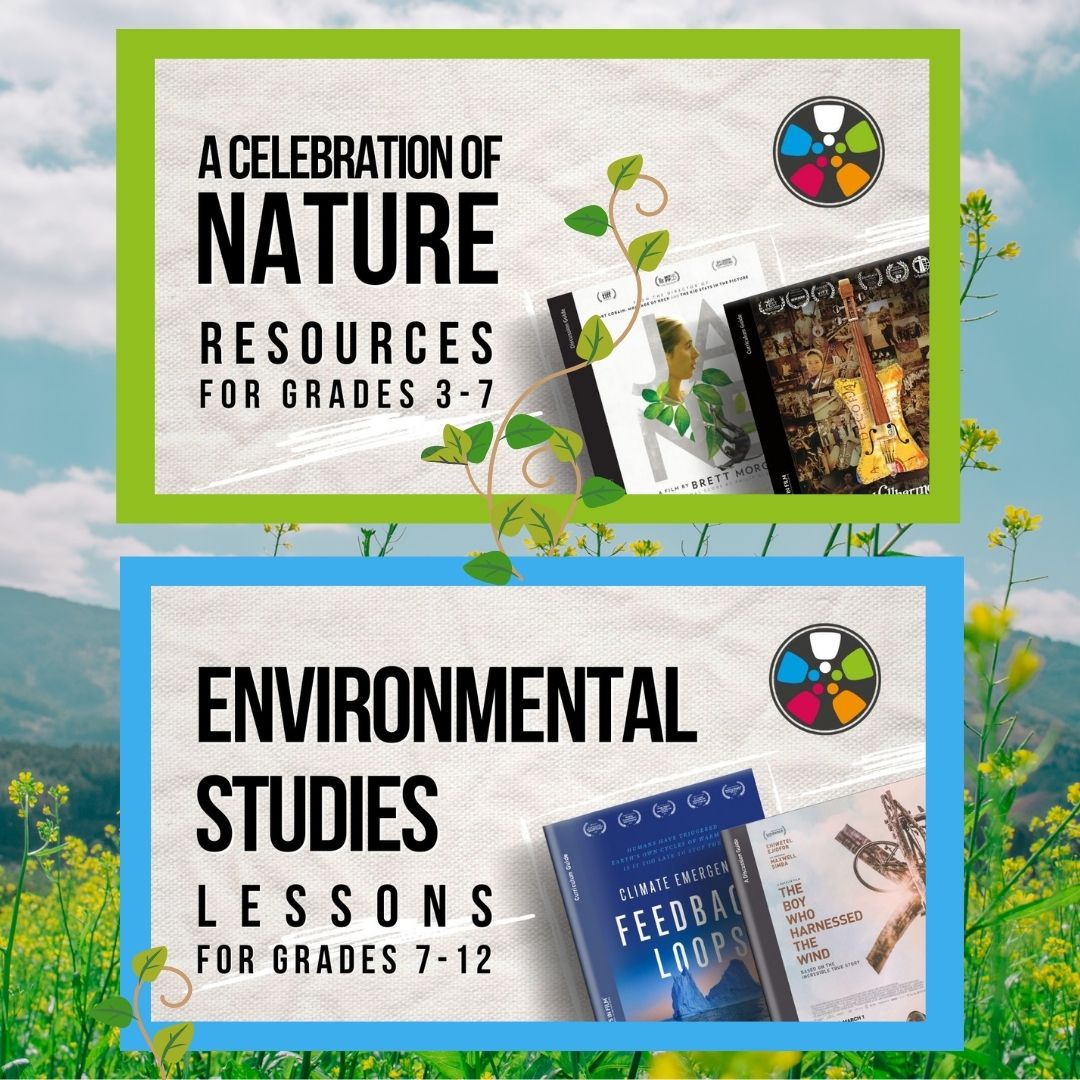
April is Earth Month! Plus April 21 – 27 is Earth Week, April 22 is Earth Day and April 26 is Arbor Day. We have collections of teaching resources that can help you celebrate the environment all month long across the curriculum: Teach With Film for Earth Month.
April Teaching Highlights
For Arab American Heritage Month, Wadjda is a film from Saudi Arabia that students love. We also recommend The Neighborhood Storyteller, a short documentary about Syrian refugee Asmaa Rashed.
For Genocide Awareness Month, we recommend our Holocaust Education films: Big Sonia, Defiant Requiem, and Schindler’s List, and our Facilitation Guidelines for leading sensitive group discussions of difficult topics.
Summer of Soul is a fantastic film to celebrate Jazz Appreciation Month.
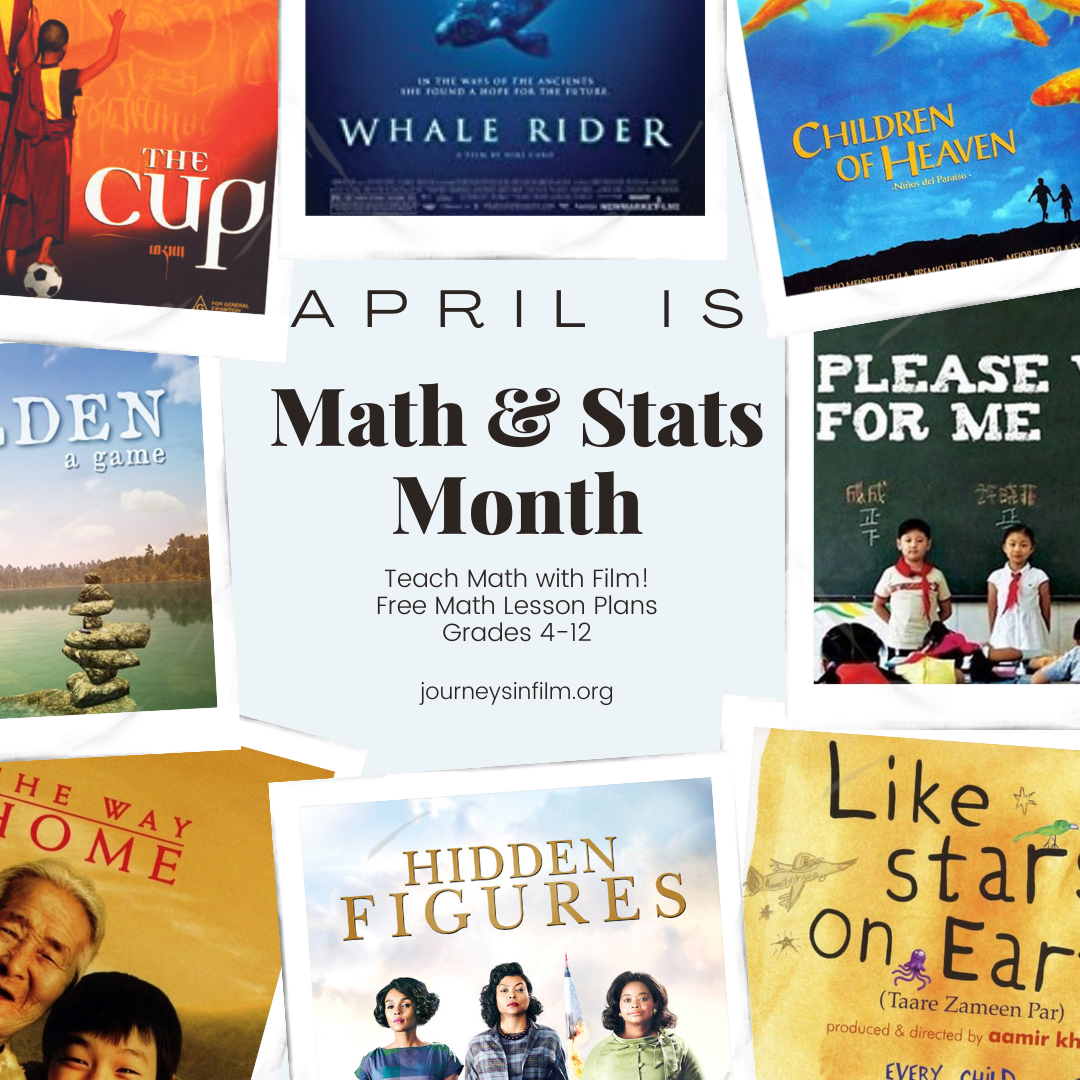
For Mathematics & Stats Month, enjoy the math lessons in our film guides for Children of Heaven, Hidden Figures, Like Stars On Earth, Please Vote For Me, The Cup, The Way Home, Walden, and Whale Rider.
For Poetry Appreciation Month, check out Kahlil Gibran’s The Prophet, the animated feature film about a poet based on the poetic writing of Kahlil Gibran.
Teach April Holidays With Film
Passover takes place April 12-20, 2025: introduce your students to Judaism with The Story of God, and share Steven Spielberg’s moving Passover Story from the making of Schindler’s List.
Teach about Public Health in April
- National Interprofessional Healthcare Month
- World Minority Health Month
- National Public Health Week April 1-7
- Black Maternal Health Week April 11-17;
- National Infant Immunization Week April 22-29
- World Immunization Week April 24-30
The Invisible Shield is a powerful teaching tool for exploring the importance of public health and public health workers, the critical role of immunizations in public health, and the urgency of addressing public health inequities to make healthcare available for all.
More April Teaching Ideas
For School Library Month, National Library Week (April 6-12, 2025), National School Librarian Day (April 4), and World Book and Copyright Day (April 23), check out these tips to Bring Books and Films Together to Inspire and Engage Students. Plus also check out our article on Educational Film Distribution: What Librarians and Teachers Need to Know.
Celebrate Stress Awareness Month + National Psychology Week with films about stress and mental wellness: Big Sonia, Gabby Giffords Won’t Back Down, Happy, and The Dhamma Brothers.
Volunteer Month is a great time to teach with our film guides featuring Service Learning & Community Service Lessons: Climate Emergency: Feedback Loops, He Named Me Malala, and Landfill Harmonic.
Week of the Young Child (April 5-11, 205) is a great time to screen Children of Heaven.
Discover the magic of forests for National Parks Week (April 19-25, 2025): Learn about Forests.
April 3: Pioneering primatologist and anthropologist Jane Goodall was born on this day in 1934. Celebrate with her biographical documentary Jane. Learn more about teaching with this film with our article at Share My Lesson: Inspiring a Love of Nature and Learning: Celebrating Jane Goodall.
April 5 is International Day of Conscience. We have a large selection of human rights-themed films that are perfect to teach on this day. Among our favorites, we recommend: Crip Camp, He Named Me Malala, Rebel Hearts, and Summer of Soul.
April 7 is World Health Day. Teach about Coal and Public Health with From the Ashes. Explore the intersection of soil health, food quality and individual health with Greener Pastures. Celebrate the heroic public health system with The Invisible Shield.
International Day of Pink on April 9 (2025) is a great day to teach with Finding Pride.
Celebrate International Day of Human Space Flight on April 12 with Hidden Figures and One Strange Rock.
April 20 is Chinese Language Day. Students will enjoy our Chinese-language film Please Vote For Me with cross-curriculum lessons for grades 4-12.
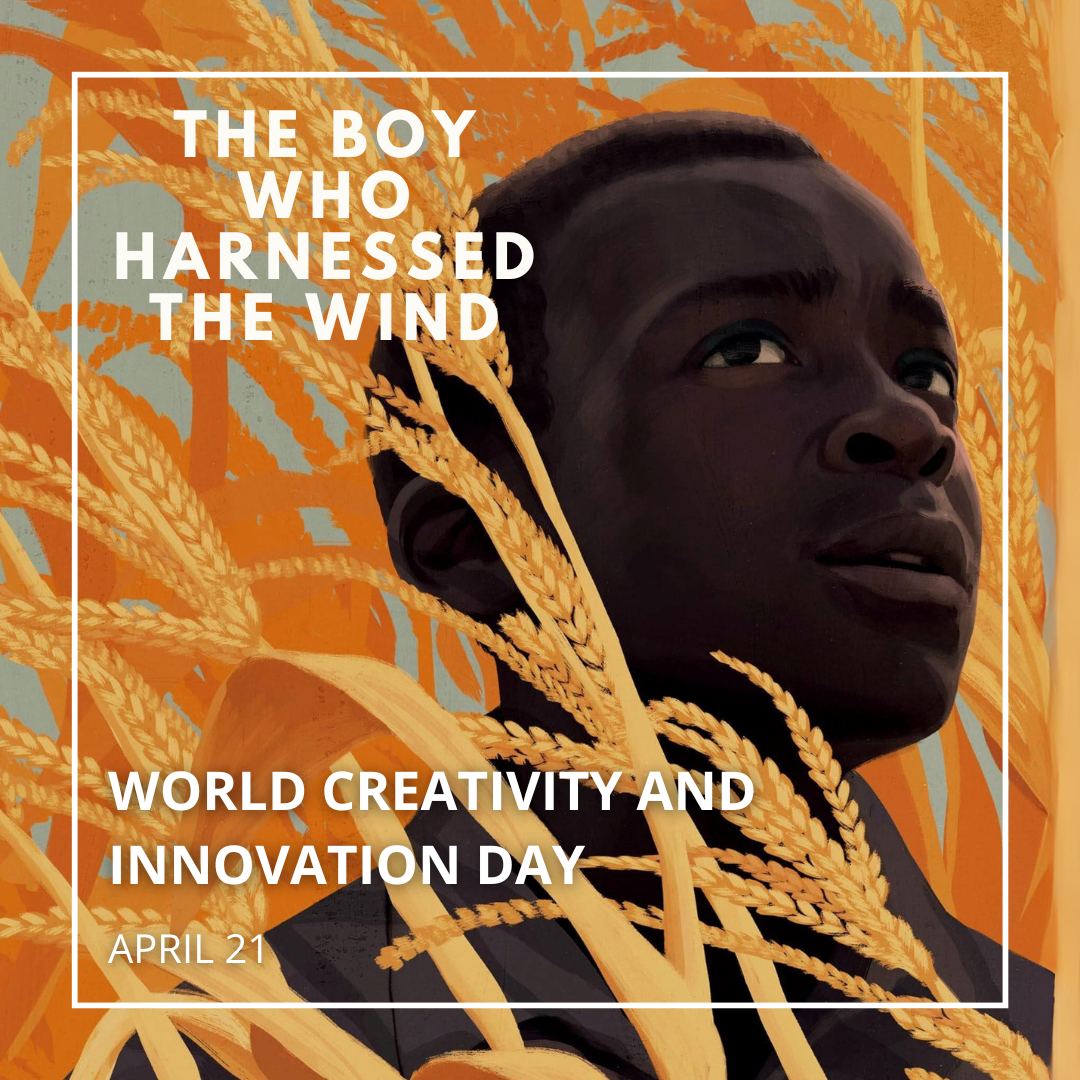
April 21 is World Creativity and Innovation Day. Celebrate innovation with The Boy Who Harnessed The Wind.
April 23 is English Language Day. We are pleased to offer over two dozen film guides with English Language Arts lessons. A great place to start is the oral history assignment for Big Sonia (grades 7-12), the Crip Camp lesson on language power and ableism (high school) , the lesson based on Malala Yousafzai’s Nobel Prize acceptance speech at age 17 for He Named Me Malala (grades 7-12), and rich, engaging lessons combining language arts, music, and social studies for The Music of Strangers: Yo-Yo Ma and the Silk Road Ensemble (grades 7-12).
April 23 is Spanish Language Day. We offer film guides in Spanish for Gabby Giffords Won’t Back Down, River of Gold, and The Love Bugs. The lessons for The Love Bugs are appropriate for Grades 3-5.
Celebrate Syria Independence Day on April 27 with The Music of Strangers.
April 25 is International Girls in ICT Day (Information and Communication Technology) inspires your students of all genders about ICT careers with Hidden Figures.
April 28: Oskar Schindler of Schindler’s List was born on this day in 1908. Introduce your students to this remarkable and complex man with Who was Oskar Schindler.
April 28 is World Day for Safety and Health at Work: Explore the impact of the coal industry on coal miners with From the Ashes.
April 30 is International Jazz Day. Wrap up April with the joyful sounds of Summer of Soul.
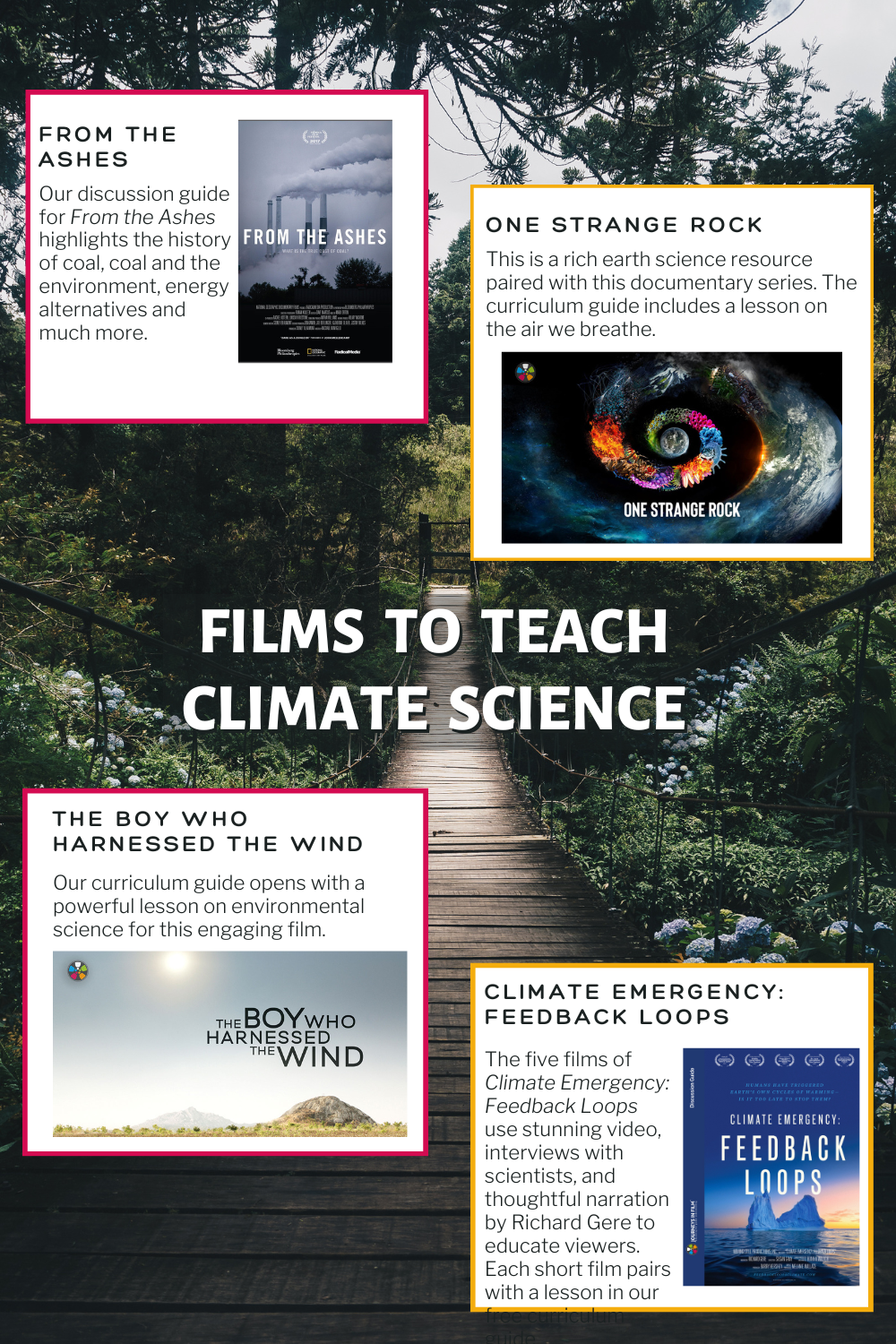
What to Teach in March
Let’s make March easy! Get classroom-ready resources to teach with film across the curriculum for Women’s History Month, Music in Our Schools Month, Pi Day (yes, you can teach math with film!), Ramadan, World Poetry Day and more!
March Special Event Highlights
Women’s History Month: Free Resources for Women’s History Month + our new Women’s History Resource Collection
Music in Our Schools Month: Chevalier, Defiant Requiem, Landfill Harmonic, Summer of Soul, The Music of Strangers
Ramadan: Teach about Islam with Film
March 14 Pi Day: Teach Math with Film
March 20 International Day of Happiness: Happy (the Happy movie!)
March Monthly Teaching Themes
Developmental Disabilities Awareness Month: Crip Camp
Gender Equality Month + Equal Pay Day falls in March (the date changes each year): Films with Gender Equity-themed lessons – He Named Me Malala, Hidden Figures, Jane, Rebel Hearts, The Neighborhood Storyteller.
National Reading Month: Boost Student Engagement with Film and Book Pairings
March Weekly Teaching Themes
Brain Awareness Week March 10-16, 2025 : Gabby Giffords Won’t Back Down – Aphasia, Happy – The Psychology of Happiness, Like Stars on Earth – How the Brain Works, The Dhamma Brothers – Meditation and the Brain
LGBTQ Health Awareness Week March 17-21: Finding Pride, The Invisible Shield
Week of Solidarity with the Peoples Struggling against Racism and Racial Discrimination March 21-27 + March 21 International Day for the Elimination of Racial Discrimination: Chevalier, Hidden Figures, Just Mercy, LA92, Summer of Soul, The Dhamma Brothers, Unzipped, Youth v Gov
*History teachers may also find our Black History Lesson collection helpful.
March Special Teaching Days
March 1 Zero Discrimination Day: What Are Prejudice, Stereotyping And Discrimination? (Video), The Invisible Shield (about social inequities and public health)
March 1 Read Across America Day: Boost Student Engagement with Film and Book Pairings
March 3 World Wildlife Day: Jane, River of Gold — or check out our Celebration of Nature Collection which introduces students to Bugs, Chimpanzees and the Natural World of the Amazon, with resources for grades 3 to 7.
March 4 World Engineering Day for Sustainable Development: The Boy Who Harnessed The Wind
March 5 (2025)* Equal Pay Day: Hidden Figures, Jane.
*This date changes each year.
March 8 International Women’s Day: Women’s History Resources + 10 Documentary Films That Celebrate Women of Faith
March 14 Hindu Festival of Holi (2025): The Story of God
March 15 International Day to Combat Islamophobia: Countering Islamophobia Through Film, 10 Documentary Films That Celebrate Women of Faith (includes great films about women in Islam).
March 15 World Consumer Rights Day: River of Gold (about consumer rights to ethically sourced gold)
March 15 International Long Covid Awareness Day: The Invisible Shield
March 19 National Agriculture Day: Greener Pastures
March 21 International Day for the Elimination of Racial Discrimination: Chevalier, Hidden Figures, Just Mercy, LA92, Summer of Soul, The Dhamma Brothers, Unzipped
*History teachers may also find our Black History Lesson collection helpful.
March 21 World Poetry Day: The Prophet
March 21 International Day of Forests: Learn about Forests for Earth Day and Every Day
March 22 World Water Day: River of Gold
March 23 Earth Hour: Environmental Studies Collection
March 23 World Meteorological Day: Climate Emergency: Feedback Loops
March 30 International Day of Zero Waste: Landfill Harmonic
March 30 Doctor’s Day: The Invisible Shield
March 31 International Day of Transgender Visibility: Finding Pride
Teach about Islam with Film
Celebrate Islam with film all year round with these global education films that center Muslim stories plus our free teaching guides.
Children of Heaven
Children of Heaven follows an Iranian brother and sister and their adventures over a lost pair of shoes. The film showcases both modern and tradition Tehran and portrays a loving family trying to do their best.
Our free Children of Heaven Curriculum Guide for grades 4-12 includes an introduction to the Islamic Republic of Iran
He Named Me Malala
He Named Me Malala follows events leading up to the Taliban’ attack on Pakistani schoolgirl Malala Yousafzai for speaking out on girls’ education, followed by the aftermath, including her speech to the United Nations.
Our free He Named Me Malala Curriculum Guide for grades 7-12 includes a lesson about examining Malala’s iconic Nobel Peace Prize address.
The Neighborhood Storyteller
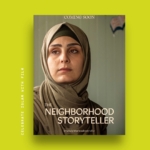 In The Neigbhorhood Storyteller, a young Syrian woman in a refugee camp in Jordan embarks on a read-aloud project to raise a new generation of successful young women.
Our The Neighborhood Storyteller Teaching Guide features connections to Muzoon: A Syrian Refugee Speaks Out by Muzoon Almellehan with Wendy Pearlman, for educators interested in doing a film-book pairing for grades 5-12.
Wadjda
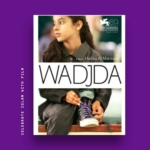 In Wadjda, a young Saudi girl signs up for her school’s Quran recitation competition as a way to raise the funds she needs in order to buy the bicycle of her dreams.
Our free Wadjda Curriculum Guide for grades 6-12 features a lesson with an introduction to the Quran.
The Story of God
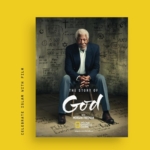 National Geographic’s docuseries The Story of God with Morgan Freeman sheds a brilliant light on the remarkable and unmistakable similarities among different faiths.
The section on Islam in our free The Story of God Curriculum Guide for or grades 4-12 includes an introduction to Muslim beliefs and practices, highlights arts of the Islamic world, explores Islamic empires, and examines Islam’s rich contributions to science.
Related Resources
Journeys in Film is a Top SML Resource of 2024

We’re thrilled that our article on Creating a Calm Classroom is part of the Best of Share My Lesson 2024!
Check out these free tools and resources to help students manage big feelings:
Creating a Calm Classroom at Share My Lesson.
More of the Best at Share My Lesson
Journeys in Film has been honored to place in the top ten most popular resources of the year at Share My Lesson for three years in a row.
Our article about Creating Safe Spaces for Student Engagement with Difficult Topics, by Executive Director Jen Fischer, was a top ten Share My Lesson Resource in 2023.
Our lesson plan for Teaching about Civil Rights with Summer of Soul was the #1 Share My Lesson Partner Content of 2022!

We are proud to partner with Share My Lesson and we warmly recommend their free educational resources. Check out more of our free articles and teaching materials available through Share My Lesson, including free professional development webinars:
Journeys in Film at Share My Lesson.
About Share My Lesson
Created and maintained by the American Federation of Teachers, Share My Lesson is a community of teachers, paraprofessionals and school-related personnel, specialized instructional support personnel, higher education faculty, and parents and caregivers who contribute content, collaborate, and stay up to date on the issues that matter to students and educators everywhere.
About Journeys in Film
Journeys in Film believes in the storytelling power of film to educate the most visually literate generation in history. Since 2003, Journeys in Film has been pioneering the use of film for interdisciplinary lessons in the classroom. We also develop discussion guides for films for powerful films designed to work in multiple settings, such as classroom discussions, after-school clubs, community screenings, college classes, adult education and more. All of the Journeys in Film educational resources are cost-free. Learn more about partnering with Journeys in Film.
Teach Holocaust Education with Film
We’re excited to share our new step-by-step guide on how to Teach Holocaust Education with Film. From award-winning documentaries to tools for fostering critical discussions, these resources help educators teach the Holocaust authentically, inspire empathy, and honor the lessons of history.
Holocaust Education Guide Highlights
1. Getting Ready to Teach Holocaust Education: instructional foundations & teaching tools for teaching Holocaust Education with Film.
2. Teaching with Holocaust Education Films: Award-winning films about the Holocaust with classroom-ready lesson plans.
3. Wrapping Up Your Holocaust Education Class: Tools for helping students process big feelings when you teach Holocaust Education.
4. When to Teach Holocaust Education: A Holocaust Education Calendar, of opportunities for sharing Holocaust Education films with your education community.
We hope the resources we have shared here will make it easy for teachers to bring Holocaust Education alive in the classroom and boost student engagement with this important subject.
Read the full article at Share my Lesson: Teaching Holocaust Education with Film.
PS We’re honored that our article was featured in the Share My Lesson newsletter!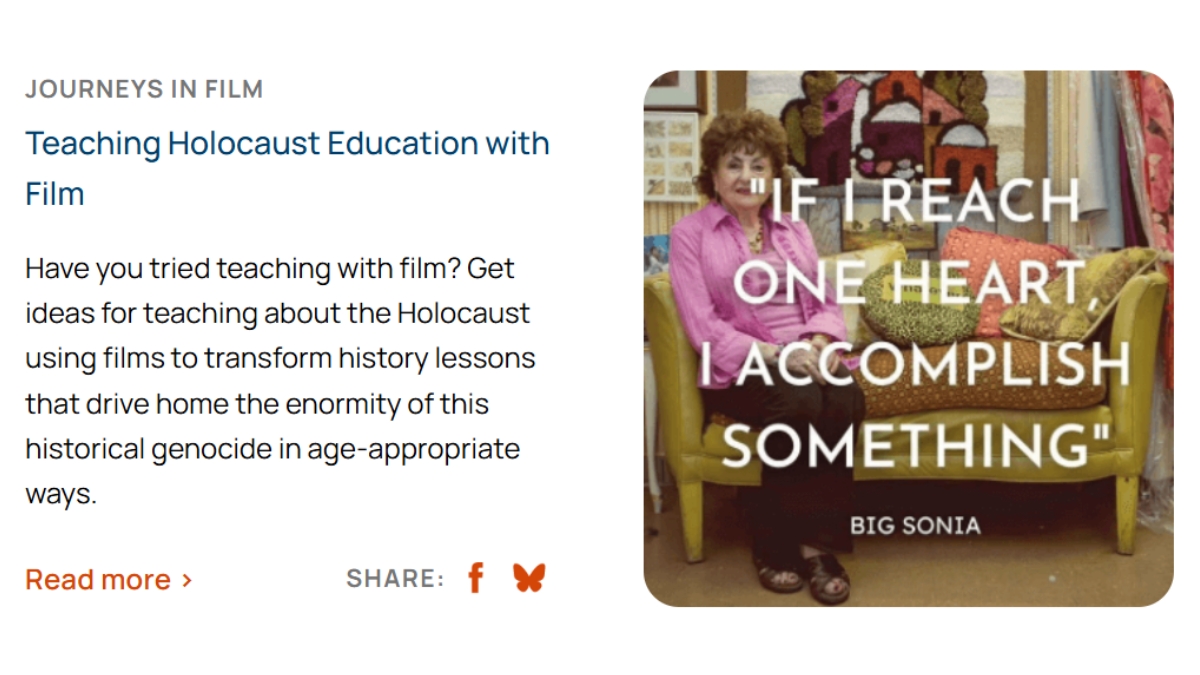
We Are Here For You
A Message from our Executive Director
For many of us and our communities, this year has begun with loss, uncertainty, and other difficult challenges. Journeys works with many educators and film professionals in Los Angeles, where the effects of multiple wildfires are devastating. Others beyond L.A. may also be affected by these events as reminders of experiences with climate disasters, relocation, or housing insecurity. Many vulnerable and systemically oppressed communities are feeling the weight and worry of a world full of hostility. At Journeys, we are feeling all of these things, too.
We want to thank you for your commitment to supporting your students, colleagues, and communities. We know that you are working to create classroom and community spaces that are safe and welcoming, a respite no matter the circumstances. We appreciate that this is incredibly difficult work.
We stand with you in this commitment to classroom safety and community. We will continue to provide free resources that not only meet educational standards, but more importantly, that focus on empathy, compassion, global understanding, and connection.
Please do not hesitate to reach out to us regarding our work and your needs. The best way to connect with us is through email. You can reach me directly at jennifer@journeysinfilm.org. We are incredibly grateful to be connected to each and every one of you and appreciate all that you do.
Jennifer Fischer
Executive Director
Journeys in Film
|