Journeys in Film sat down with filmmaker Leah Warshawski, director of Big Sonia, as part of a project with the Library of Congress: “Stories That Connect: Using Film and Primary Sources to Build Belonging.” Learn more about that webinar series.
Bring the History of the Holocaust into the Classroom Through Film
Educators (and parents) have always had the difficult task of guiding young people through the complicated work of growing, learning, and becoming themselves. However, today’s young people are transitioning to adulthood during a time of rapid social and technological change and upheaval. Our pockets are buzzing multiple times a day, demanding our attention, mostly to inform us of situations far beyond anything we can control. It is exactly this set of circumstances that makes Big Sonia a powerful educational tool for middle-school and high-school classrooms. Big Sonia offers opportunities for learning about the history of World War II, while offering students a model for working through challenges over time. Big Sonia illustrates how much one life has the potential to positively affect the world around them.
“That’s really the whole idea…one person has the power to impact one person, has the power to impact one person. And it’s a huge chain reaction.” — Student on the impact of hearing Sonia’s story, Big Sonia.
Sonia’s Incredible Story
Sonia and her husband John, whom she met at the Displaced Persons camp at Bergen-Belsen, had witnessed atrocities during World War II. The horrors are something that many survivors would like to forget (and most of the rest of us try not to imagine). However, Sonia recounts she ‘awakened’ to her purpose of sharing her story or survival after hearing white supremacist skinheads deny that the Holocaust had ever happened. She thought, “Hey Sonia, this is the reason you survived.”
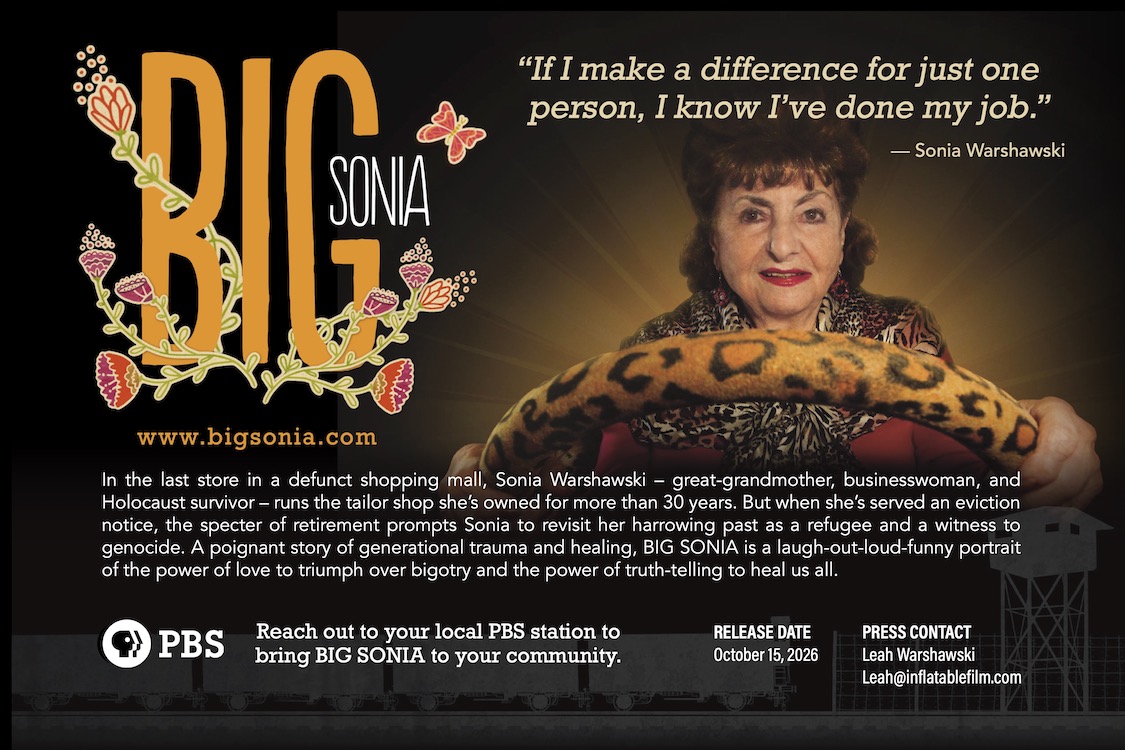
This is where the film begins: meeting the tenacious 4’8” grandmother, still running her late husband’s tailor shop, John’s Tailoring, the last business standing in what was once a bustling mall. The shop she and her husband built together was not only a business, but a place where people came to connect and share stories. This is where the story of survivorship unfolds. We learn how her family hid from the Germans under a trapdoor in her home in Poland. We also discover how they were found. Sonia spent what would have been her middle and high school years in three different concentration camps. But, she miraculously lived after being shot on Liberation Day. Sonia has spent the last decades of her life speaking to schools, community groups, and to people in prisons.
“She’s a Kansas City treasure. I’ve been coming since 1987 and I knew–since the first time I walked in when I was a young punk college kid–I knew I was looking at history.”– Customer of John’s Tailoring, Big Sonia
A Filmmaker on Telling Her Grandmother’s Story
Filmmaker Leah Warshawski had long quipped that her grandmother’s tailor shop and big personality would make for excellent reality TV. Yet it wasn’t until after filming Sonia speaking with a group of middle-schoolers that she realized the impact Sonia’s story was having on individual young people. She immediately realized her story needed to be captured on film, and understood that film needed to be made now. “Sonia was 84 when we started. We felt a lot of pressure and stress to finish the film while she was still alive,” said Warshawski. “There was an emotional toll on our family. We felt a ticking clock.”
In fact, beyond Sonia’s harrowing story or the historic event she survived, it is the family dynamics that make the film so compelling. Sonia’s children recount what it was like to grow up in the shadow of the Holocaust. Their stories might be the most relatable to today’s young people, as they rely on adults to help prepare them for adulthood while reckoning with their own struggles as they face the realities of today’s world. Leah doesn’t shy away from acknowledging the challenges of working with her family or traumatic subject matter. Regarding the process of the filmmaking and the response to the film, Leah shares: “There’s some healing that took place and is still taking place. It didn’t wrap things up in a bow, but it opened up some new pathways.”
That is the potential of sharing a great film in the classroom. It may not magically transform a student or set them on their life’s journey (although that might happen too), but it does invite them to open a new pathway of perspective.
An Innovative Filmmaking Approach
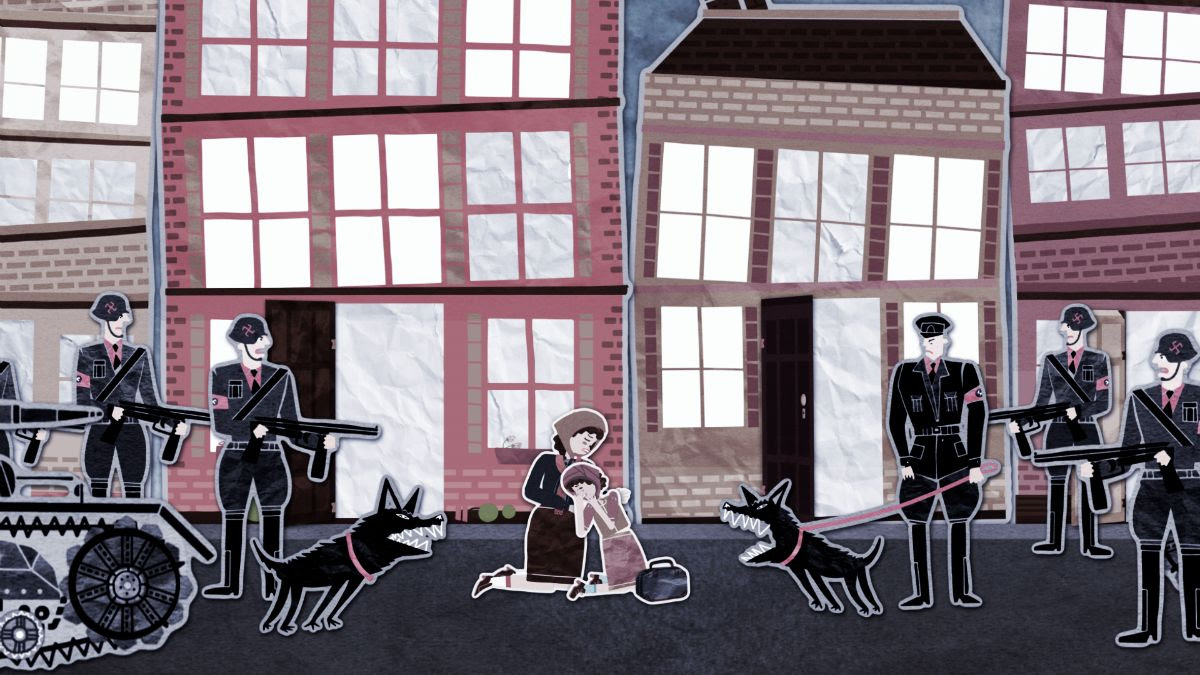
For Leah, it was important that the film didn’t cover the same ground other WWII or Holocaust films had. She didn’t want to use the WWII black-and-white photos and footage that have been shown for decades. Instead, she used Sonia’s doodles—a coping mechanism Sonia employed since childhood to keep her hands and mind busy—as a visual springboard to animating scenes from Sonia’s harrowing past. The animation not only makes the film more dynamic and accessible to a younger audience. It also doesn’t risk traumatizing young viewers with war footage, or, perhaps worse, further desensitizing them. It was important not to present violent imagery and black-and-white illusions that make these types of atrocities feel of the the past. Rather, Leah sought to connect this to the present. As such, students will find multiple access points into the narrative as animation, poetry, and intergenerational resilience are woven together.
“Experience is everything. It takes people who’ve been through something to reach people who are going through something.” – Reaching Out from Within participant at the Lansing Correctional Facility, Big Sonia
Ethical Storytelling, Primary Sources, Oral Histories and Advice for Budding Filmmakers
Washawski also expanded on the importance of ethical storytelling and learning from history. While Sonia’s experience was the primary source material that launched the project, the film team worked with the Midwest Center for Holocaust Education, an advisory board, and Yad Vashem, the World Holocaust Remembrance Center. Warshawski explains, “Sonia has a really good memory. But her memory, like all of our memories, is affected by nostalgia, time, and emotions. You want to take what people are saying as fact, especially about their own lives. Still, when making a film, writing a book, or something that is going to be published, we had to make sure that the information we are presenting is historically accurate.”
Leah’s advice to young people looking to start in any creative industry is:
“You don’t have to have all of the technical ‘know-how’ to get hired. But you do need to be a kind, good person. The way my dad would put it is: ‘having good comportment,’ which means the way you show up, the kind of attitude you have. Spend as much time on personal development as you would on technical development. Learn how to navigate human relationships—learn to show up on time, write an email back, be communicative. Those things mean a lot. I had a mentor who gave me one piece of advice that I think about daily: The best captain is the best crew. Do the work the best way you know how, no matter what your title.”
The Importance of Being an Upstander
While Big Sonia captures a remarkable oral history, it also models upstanding, an extraordinary work ethic, intergenerational healing, and resilience. The film also creates a bridge for students to learn from the past while contributing to a hopeful future in the present.
Leah stressed the importance of the upstander message of the film: no matter your vocation, you can be an upstander–a person who confronts injustice when it happens.
As you seek to inspire and engage your students this school year, Journeys in Film invites you to watch Big Sonia with your students to bring history and hope to life on screen and in your classroom.
Fun Fact: Big Sonia screened at the Library of Congress in 2016!
Find the Resources, Access the Film
Learn more or donate the Educational Toolkit and License to your local school, library, or community group.
Related Library of Congress Primary Source Collections
Collection: Roman Totenberg Papers: Totenberg-Wilk Holocaust Material
New Primary Source Set for World War II from the Library of Congress