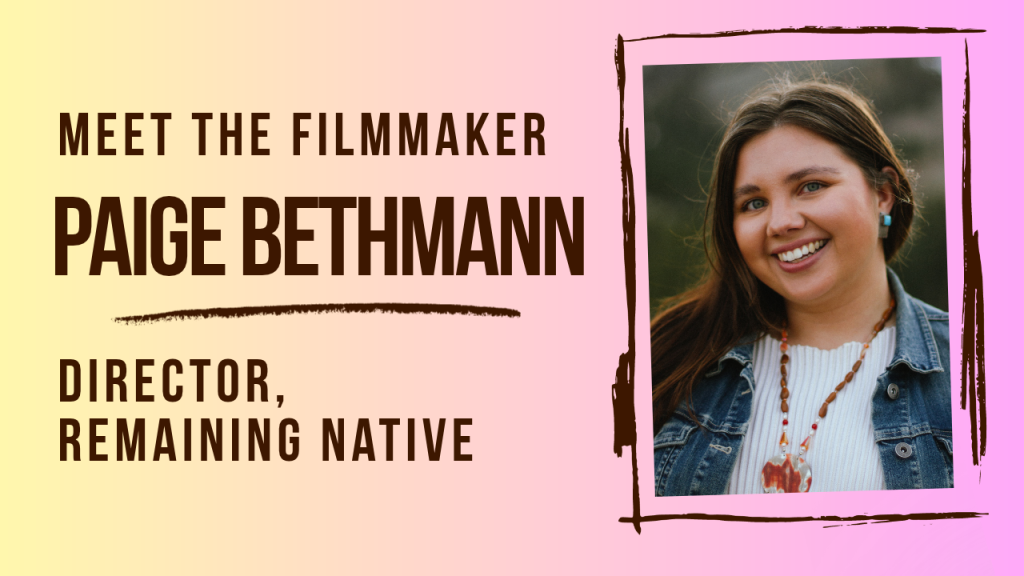
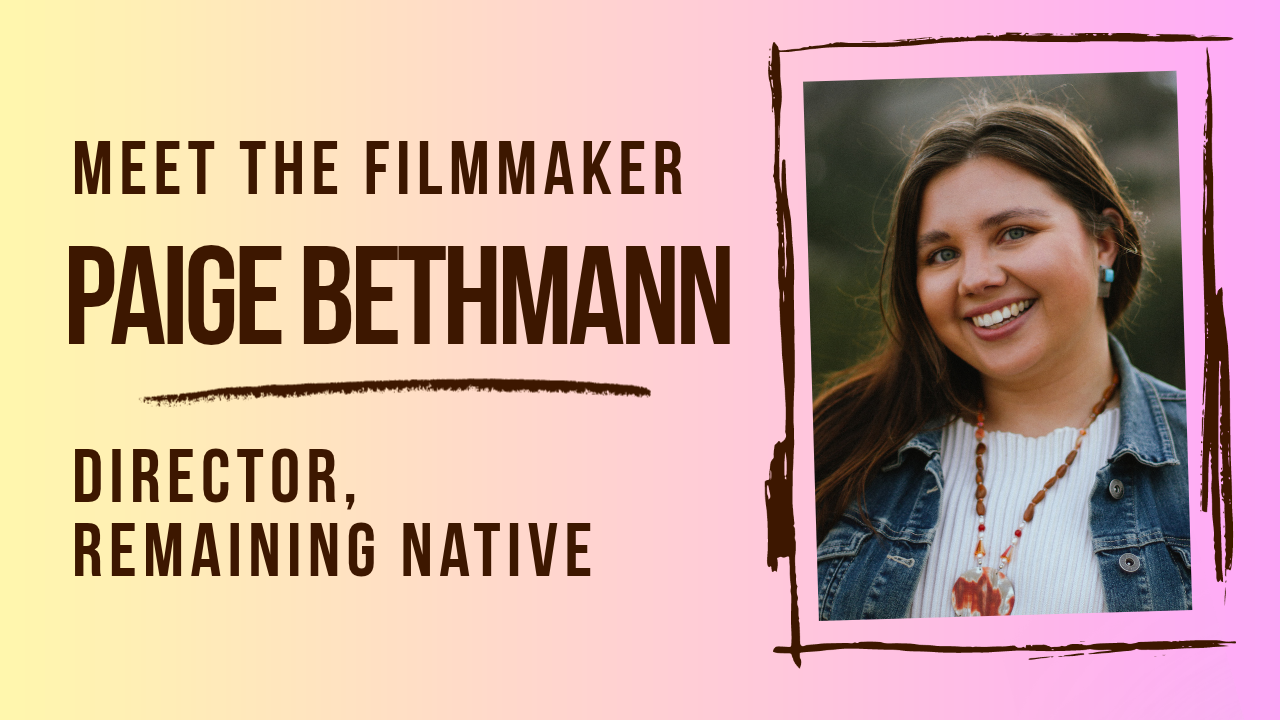
Remaining Native is a teaching tool for this generation. It does not hide the tragedies of the past, nor does it create the sense that there is no possibility of moving forward. Journeys in Film interviewed filmmaker Paige Bethmann to discuss the origin story of Remaining Native, how the film activates community spaces, and the lessons learned during its creation that can help educators, elders, and young people connect and learn from their own lived experiences.
Preparation Meets Inspiration
Paige’s father came from the Akwesasne Mohawk Reservation, and her mother is Oneida, from outside of Syracuse. Growing up, she was very close with her paternal grandmother, who was a traditional Mohawk storyteller. Her grandmother was also a community organizer who ran an after-school program for Native kids. She created a space where Native children had a daily, felt sense of belonging. Additionally, they were provided opportunities to explore their Native identity through crafting, field trips, and shared learning.
In her school years, Paige was a competitive figure skater. Her deep love for sports and storytelling led her to attend film school at Ithaca College. She later interned with NBC Olympics in Sochi, Russia. After she graduated, she moved to New York City and worked in advertising, She spent six years creating long- and short-form non-fiction video content for Vox Media.
Breaking News, Connecting the Past and Present
In 2021, a succession of events challenged her both personally and professionally. First, breaking news from Kamloops, Canada, informed the world of 215 unmarked graves of Native children on the grounds of a former Indian boarding school. While this made headlines around the world, the story activated Paige’s own family memories. Paige herself is a descendant of a survivor of a United States Indian boarding school.
Soon after, a friend of Bethmann’s shared an article from the Reno Gazette Journal about a Paiute teenager, Ku Stevens. Ku wanted to run the 50-mile distance his great-grandfather had run when he was an 8-year-old child. Ku’s great-grandfather was escaping the abuses of the Stewart Indian School, which he had been forced to attend.
Bethmann was moved by the heartbreaking story of a child trying to run home, and curious about that child’s descendant. Who was this self-aware, 17-year-old kid who wanted to use his skills and passion to honor his family?
Bethmann’s paternal grandmother had recently died, and this confluence of events prompted her to reach out to Ku’s mother to request permission to film Ku’s “Remembrance Run.” While she hadn’t made her own independent film before, her experience working at Vox had given her all the requisite skills. She knew how to assemble a crew, use technology to tell and share stories. Finally, with permission from Ku’s family, she set out to make a short film about the run.
Creating in Community
For Bethmann, Ku’s story wasn’t simply capturing a moment in time or a history lesson triggered by a current event. Rather, it was layered and complex. It was both deeply individual and broadly connected to a complex network of other people, places, past traumas, and real hopes for the future. By following the thread of Ku and his family as they work toward his goal of becoming a D1 runner, the landscape of his ancestral lands came to life as a living, breathing character in the film. Ku’s feet pound the pavement in rhythm with his breath. There are undeniable echoes of his grandfather’s journey across the same ancestral landscape. The viewer comes to see the stories of Ku, his parents, and his grandfather as a circular pattern of leaving, returning, and creating home through participation in and contribution to community spaces.
As Bethmann talked about the film project with people she met, she found that they were often as inspired and activated by the story as she was. Weaving her own lived experience with the lessons from her grandmother, Bethmann realized the story she was telling needed to be treated as an eco-system. For her, flying in from New York and extracting a story, regardless of good intentions, was not an option. Bethmann chose to leave her job at Vox and relocate. She wanted to live, learn, and work to tell Ku’s story in a way that made the final film and the filmmaking process reciprocal and generative.
Creating Your Classroom Environment
Despite all obstacles, the educators that Paige Bethmann knows and respects across the country are doing incredible work to foster student growth and well-being. Imagining and preparing for the beginning of a new school year is an art that requires both skill and creativity to integrate lessons learned from prior classes, playtest new curriculum, and adapt to meet new students’ needs in an incredibly complex educational landscape. Bethmann points to this complexity when speaking about the long history of the Stewart Indian School, where Ku’s run ends. Now renamed the Stewart Indian Cultural Center and Museum, Bethmann points out, “You have people who call themselves alumni…and people who call themselves survivors.”
Native American history is foundational and integral to United States history. Additionally, Native American history connects our nation to global conversations around sovereignty, ecology, and human rights. Yet, it has not taken center stage in the histories we have inherited in U.S. classrooms. Remaining Native delivers a powerful demonstration of how much one person can do by simply creating a space for people to gather.
Teaching Tips
Here are some Remaining Native takeaways as you create your classroom environment:
You are part of the ecosystem you are creating for your students. As you are carefully crafting extraordinary learning experiences for your students, work your own self-care plan into the academic calendar. Click on the link to access Purdue Global’s Complete Guide to Self-Care for Educators.
Movement is necessary for healthy individuals and healthy communities. Beyond P.E., weave movement throughout the school day. See Education Week’s Activate the Classroom: Tips for Incorporating Movement for downloadable resources to adapt for your classroom.
Learners thrive in environments that both challenge and support them. Check out Columbia University’s Center for Teaching and Learning resource: Creating a High Trust, Low Stress Class Environment.
Make complexity something your students expect to engage with. Check out Design for Classroom Complexity to think about how to incorporate experimentation and creative thinking into your course design so students can learn from, and not fear, making mistakes.
Connect with people who have shared experiences. Being the leader in a classroom every day is hard work. You can start by reading the National Teaching Association’s Finding Your Family of Fellow Educators.
Bring Remaining Native Into Your Classroom
We have two free teaching resources for this powerful film!
–> A Learning Guide for use for Media Literacy, Social Studies, Native American History, English Language Arts and More. Includes: Active Viewing Worksheet, Writing a Film Review Worksheet, Listening Skills Handout, Documentary Note Catcher Handout, Federal Indian Boarding School Initiative Investigative Report, Related Poetry and Poetry Activities and more.
–> Moving Forward Together Learning Guide for use for Physical Education, Health, community runs, wellness gatherings and discussions, family engagement with the film and movement, and more.
Additionally, Remaining Native worked together with Indigenous educators to create sample regional resources and/or notes for educators. Access the Regional Adaptations Here.